Lith Corporation, founded in 1998 by a group of material science doctor from Tsinghua University, has now become the leading manufacturer of battery lab&production equipment. Lith Corporation have production factories in shenzhen and xiamen of China.This allows for the possibility of providing high quality and low-cost precision machines for lab&production equipment,including: roller press, film coater,mixer, high-temperature furnace, glove box,and complete set of equipment for research of rechargeable battery materials. Simple to operate, low cost and commitment to our customers is our priority.
Inert Glovebox: A Comprehensive Guide
An inert glovebox is a specialized enclosed workspace designed to provide an environment free of reactive gases such as oxygen, moisture, or other contaminants. It is widely used in scientific research, pharmaceuticals, electronics, and materials science to handle sensitive materials that degrade or react when exposed to air.
Below is an indepth exploration of inert gloveboxes, including their design, operation, applications, advantages, limitations, and key considerations.
●1. What Is an Inert Glovebox?
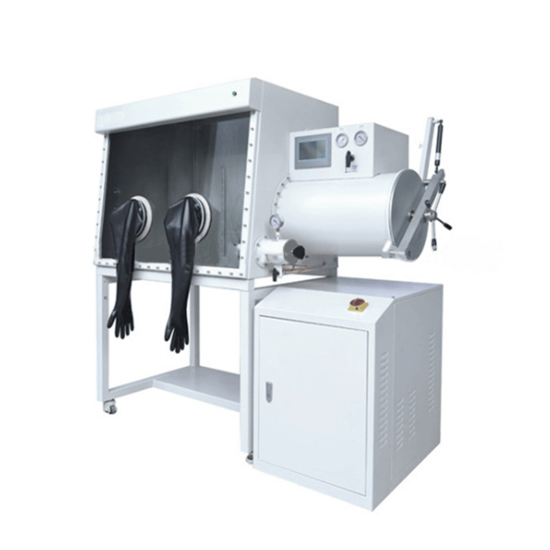
An inert glovebox is a sealed chamber filled with an inert gas (typically nitrogen or argon) to create an atmosphere free of reactive gases like oxygen, water vapor, or carbon dioxide. The box is equipped with gloves mounted on the walls, allowing users to manipulate materials inside without exposing them to external air.
●2. Components of an Inert Glovebox
A. Enclosure
Airtight chamber made of materials like stainless steel, acrylic, or glass.
Transparent panels allow visibility into the workspace.
B. Gloves
Flexible gloves mounted on the walls for manual manipulation of materials inside the box.
Made of durable materials like butyl rubber or neoprene.
C. Gas Purge System
Supplies and circulates inert gas (e.g., nitrogen or argon) to maintain the desired atmosphere.
Includes gas regulators, flow meters, and purifiers.
D. Airlock Chamber
A separate compartment used to transfer materials into and out of the glovebox without compromising the internal atmosphere.
Often includes a vacuum pump and backfill system.
E. Monitoring Systems
Sensors to measure oxygen, moisture, and pressure levels inside the box.
Displays and alarms alert users to deviations from set parameters.
F. Filtration System
Removes impurities and contaminants from the inert gas before recirculation.
●3. How Does an Inert Glovebox Work?
1. Gas Purging:
The glovebox is filled with inert gas to displace air and reduce oxygen and moisture levels.
Purifiers remove trace amounts of reactive gases.
2. Material Transfer:
Materials are placed in the airlock chamber, which is evacuated using a vacuum pump.
The chamber is then backfilled with inert gas before opening it to the main glovebox.
3. Operation:
Users manipulate materials through the gloves while maintaining a controlled atmosphere inside the box.
4. Monitoring:
Sensors continuously monitor oxygen and moisture levels, ensuring they remain within specified limits.
●4. Types of Inert Gloveboxes
A. SingleChamber Gloveboxes
Consist of one main chamber with an attached airlock.
Suitable for smallscale or laboratory applications.
B. DualChamber Gloveboxes
Feature two independent chambers connected by an airlock.
Allow simultaneous work on different materials or processes.
C. Modular Gloveboxes
Designed to be expandable, allowing additional chambers or modules to be added as needed.
Ideal for largescale or complex operations.
●5. Applications of Inert Gloveboxes
A. Scientific Research
Handling airsensitive chemicals, catalysts, or materials for synthesis.
Studying reactions under controlled atmospheres.
B. Pharmaceuticals
Formulating and processing drugs that degrade in the presence of oxygen or moisture.
C. Electronics
Manufacturing lithiumion batteries, semiconductors, and other sensitive components.
D. Materials Science
Working with metals, alloys, or ceramics that oxidize or corrode in air.
E. Energy Storage
Developing and testing new battery technologies, such as solidstate batteries.
Vacuum Glove Box
●6. Advantages of Inert Gloveboxes
1. Controlled Environment:
Maintains precise levels of oxygen, moisture, and other gases.
2. Protection of Sensitive Materials:
Prevents degradation or contamination of airsensitive substances.
3. Safety:
Reduces risks associated with handling hazardous materials.
4. Versatility:
Can be customized for various applications and industries.
5. Reproducibility:
Ensures consistent results by eliminating variability caused by atmospheric conditions.
●7. Limitations of Inert Gloveboxes
1. High Initial Cost:
Purchase, installation, and maintenance can be expensive.
2. Complex Setup:
Requires careful calibration and monitoring of gas systems.
3. Limited Mobility:
Once installed, the glovebox is typically fixed in place.
4. Glove Restrictions:
Manipulating fine or delicate materials through gloves can be challenging.
●8. Factors Influencing Performance
| Factor | Impact on Performance |
|||
| Gas Purity | Higher purity inert gas improves performance and reduces contamination. |
| Sealing Integrity | Airtight seals are critical to maintaining the controlled atmosphere. |
| Moisture and Oxygen Levels | Lower levels ensure better protection for sensitive materials. |
| Temperature Control | Stable temperature minimizes condensation and material instability. |
●9. Key Manufacturers of Inert Gloveboxes
| Manufacturer | Key Features |
|||
| MBRAUN | Offers highperformance gloveboxes for research and industry. |
| Vacuubrand | Specializes in compact and modular glovebox systems. |
| Heraeus | Provides advanced solutions for materials science and electronics. |
| Coy Laboratory Products | Known for reliable and affordable gloveboxes for laboratories. |
●10. Maintenance and Optimization Tips
1. Regular Inspections:
Check seals, gloves, and connections for wear or leaks.
2. Gas Quality:
Use highpurity inert gas and replace filters regularly.
3. Calibration:
Periodically verify sensors and adjust settings as needed.
4. Training:
Ensure users are properly trained in safe operation and material handling.
5. Cleaning:
Clean the interior and exterior of the glovebox to prevent contamination.
●11. Future Trends in Inert Gloveboxes
1. Automation:
Integration of robotic arms or automated systems for enhanced precision.
2. Smart Technology:
Realtime monitoring and data analytics for improved control and efficiency.
3. Sustainability:
Development of energyefficient designs and recyclable components.
4. Customization:
Tailored solutions for specific industries and applications.
●12. Conclusion
Inert gloveboxes are essential tools for creating and maintaining controlled environments for sensitive materials and processes. Their ability to eliminate reactive gases ensures the safety, stability, and reproducibility of experiments and manufacturing operations. While they come with certain challenges, ongoing advancements continue to enhance their functionality, reliability, and userfriendliness.
If you're considering purchasing or using an inert glovebox, carefully evaluate your needs, operational requirements, and longterm goals to select the best solution for your business.
For further details or assistance in choosing the right inert glovebox, feel free to ask!


 +86 13174506016
 Louis@lithmachine.com
 +86 18559646958
 18659217588
 English ▼


