Lith Corporation, founded in 1998 by a group of material science doctor from Tsinghua University, has now become the leading manufacturer of battery lab&production equipment. Lith Corporation have production factories in shenzhen and xiamen of China.This allows for the possibility of providing high quality and low-cost precision machines for lab&production equipment,including: roller press, film coater,mixer, high-temperature furnace, glove box,and complete set of equipment for research of rechargeable battery materials. Simple to operate, low cost and commitment to our customers is our priority.
Laboratory Tablet Press: A Comprehensive Guide
A laboratory tablet press is a compact and precise machine designed for producing small batches of tablets in research, development, and quality control settings. It is widely used in pharmaceuticals, nutraceuticals, cosmetics, and other industries to test formulations, optimize processes, and produce samples for analysis or clinical trials.
Below is an indepth exploration of laboratory tablet presses, including their design, operation, applications, advantages, limitations, and key considerations.
●1. What Is a Laboratory Tablet Press?
A laboratory tablet press is a scaleddown version of industrial tablet presses, specifically tailored for lowvolume production and experimentation. It compresses powdered materials into solid tablets by applying mechanical force through punches and dies. These machines are versatile, allowing users to adjust parameters such as pressure, speed, and tablet size/shape.
●2. Components of a Laboratory Tablet Press
A. Punches and Dies
The punches (upper and lower) and die form the core of the compression system.
The die determines the shape and size of the tablet, while the punches apply pressure to compress the powder.
B. Hopper
A container that holds the powdered material to be compressed.
Feeds the material into the die cavity.
C. Compression System
Consists of cams, rollers, or hydraulic systems that control the movement of punches and the applied pressure.
D. Ejection Mechanism
Removes the compressed tablet from the die after formation.
E. Control Panel
Allows users to set and monitor parameters such as compression force, rotation speed, and fill depth.
●3. How Does a Laboratory Tablet Press Work?
1. Material Loading:
Powdered material is loaded into the hopper.
2. Filling:
The material fills the die cavity as the lower punch retracts.
3. Compression:
The upper and lower punches apply force to compress the powder into a solid tablet.
4. Ejection:
The lower punch pushes the tablet out of the die cavity.
5. Collection:
The tablet is collected in a designated tray or container.
●4. Types of Laboratory Tablet Presses
A. SinglePunch Tablet Press
Features a single station with one die and two punches.
Ideal for smallscale experiments and testing.
B. Rotary Tablet Press
Contains multiple stations arranged in a circular pattern.
Suitable for slightly larger batch sizes and higher throughput.
C. Manual Tablet Press
Operated manually, often for very smallscale testing or educational purposes.
D. Automatic Tablet Press
Controlled electronically, offering precise adjustments and automation for consistent results.
●5. Applications of Laboratory Tablet Presses
A. Pharmaceuticals
Developing and testing new drug formulations.
Producing tablets for clinical trials or stability studies.
B. Nutraceuticals
Creating dietary supplements, vitamins, and herbal products.
C. Cosmetics
Manufacturing solid cosmetic products like pressed powders or compact foundations.
D. Research and Development
Experimenting with binder agents, excipients, and active ingredients.
E. Quality Control
Ensuring uniformity and consistency in tablet properties.
●6. Advantages of Laboratory Tablet Presses
1. Precision:
Offers fine control over compression force, tablet weight, and dimensions.
2. Versatility:
Can handle a wide range of materials and formulations.
3. Compact Design:
Takes up minimal space in laboratories.
4. CostEffective:
Lower cost compared to industrialscale tablet presses.
5. Ease of Use:
Simple setup and operation, even for nonexperts.
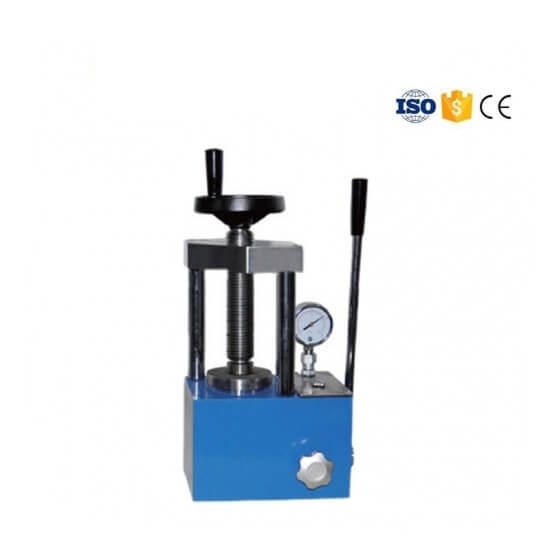
Laboratory Dry Pressing Machine
●7. Limitations of Laboratory Tablet Presses
1. Limited Capacity:
Designed for small batches; not suitable for largescale production.
2. Maintenance Requirements:
Regular cleaning and calibration are necessary to ensure accuracy.
3. Complex Formulations:
May struggle with highly complex or sticky materials without optimization.
4. Speed Constraints:
Slower production rates compared to industrial presses.
●8. Factors Influencing Performance
| Factor | Impact on Performance |
|||
| Compression Force | Determines tablet hardness and density. |
| Fill Depth | Affects tablet weight and uniformity. |
| Die Size and Shape | Influences tablet geometry and compatibility with molds. |
| Material Properties | Hardness, flowability, and cohesiveness affect compression. |
| Machine Calibration | Ensures accurate and repeatable results. |
●9. Key Manufacturers of Laboratory Tablet Presses
| Manufacturer | Key Features |
|||
| Korsch | Offers highprecision laboratory presses for R&D. |
| Fette Compacting | Provides reliable and customizable tablet presses. |
| LFA Laborsysteme | Specializes in compact and userfriendly designs. |
| Hatai Pharma Machinery | Known for affordable and durable laboratory presses. |
●10. Maintenance and Optimization Tips
1. Regular Cleaning:
Clean punches, dies, and other components after each use to prevent contamination.
2. Lubrication:
Apply lubricants sparingly to punches and moving parts to reduce wear.
3. Calibration:
Periodically verify and adjust settings for compression force, fill depth, and ejection.
4. Training:
Ensure operators are trained in proper usage and safety protocols.
5. Material Preparation:
Optimize powder flowability and particle size for better compression performance.
●11. Future Trends in Laboratory Tablet Presses
1. Automation:
Integration of automated systems for faster setup and data collection.
2. Smart Technology:
Use of sensors and software for realtime monitoring and process optimization.
3. Sustainability:
Development of ecofriendly materials and energyefficient designs.
4. Customization:
Tailored solutions for specific industries and applications.
●12. Conclusion
Laboratory tablet presses are essential tools for researchers, developers, and manufacturers working with solid dosage forms. Their ability to produce consistent, highquality tablets in small quantities makes them indispensable for formulation testing, quality control, and pilotscale production. While they have certain limitations, ongoing advancements continue to enhance their functionality, precision, and userfriendliness.
If you're considering purchasing or using a laboratory tablet press, carefully evaluate your needs, operational requirements, and longterm goals to select the best solution for your business.
For further details or assistance in choosing the right laboratory tablet press, feel free to ask!


 +86 13174506016
 Louis@lithmachine.com
 +86 18559646958
 18659217588
 English ▼


